Interview Tips
What to Write in a Keepsake Book or a Book Given as a Gift
Giving a book? Try "For your stories. Start anywhere. I'll read every word." More gift inscriptions, plus keepsake and memory book lines to copy.
Kindred Tales Editorial
Editorial team

When you give a book as a gift, write the date, both names and one line about why you chose it, such as "For Mom, who read to me every night until I pretended I was too old." Inside a keepsake book or memory book, write one specific memory, what the person means to you, and a wish for them. Three sentences in your own voice are enough.
Below are short examples you can copy or change, grouped by who the book is for. Inscribing a book you're giving? Jump to the gift inscriptions.
What should you write in a keepsake or memory book?
Most good entries have the same three parts, even the very short ones.
- A memory. One moment, with a detail in it, such as a place, a smell or something they said.
- What it meant. What that moment showed you about them, or what it changed for you.
- A wish or a thank-you. Something looking forward, or something you never quite said out loud.
Put together, it reads like this.
One detail does the work: the cold butter. If you only have room for one sentence, make it the memory.
What to write in a memory book for a friend
In a memory book for a friend, write one moment you shared, with a detail only the two of you know, then a line on what they mean to you. A friend's memory book usually marks a goodbye or a milestone: a move, a graduation, a 40th or a 50th. Keep it light, and specific. Some lines to adapt:
- "Every time I hear that song I'm back in your car with the broken heater, singing it wrong. Thank you for all the road trips."
- "You were the first person I called when I got the job, and the first when I lost it. You picked up both times."
- "I don't know who I'd have been in college without you, but I'd have eaten worse and laughed less."
- "New city, same rule. You call me when you get there."
- "Happy 50th. I'm keeping the photo from the lake house on my fridge, and you can't make me take it down."
- "Thank you for showing up with soup and staying to do the dishes. I've tried to be that friend ever since."
- "Remember the night we got lost looking for the concert and ended up at the diner instead? I'd pick the diner again."
- "You're the only person I can sit with for an hour and not need to talk."
- "You still owe me a phone call every Sunday, new city or not."
- "Thank you for telling me the truth when I needed it, and for being nice about it most of the time."
What to write in a keepsake book for a parent or grandparent
A specific memory is harder to wave off than praise. Try one of these.
- "You never missed a game, even the ones in the rain. I didn't notice that until I had kids of my own."
- "Thank you for the Saturday drives, and for answering every one of my questions about everything we passed."
- "I make your chili every winter. It's never quite right. I keep trying."
- "Grandpa, you taught me to fish, to shake hands and to lose at cards without sulking."
- "Everything I know about being kind to strangers, I learned watching you at the hardware store."
If the book is meant to hold their life story, put a short note on the first page about why you wanted it made. Something like "I wanted your stories in one place, in your words, so my kids can know you the way I do."
What to write in a wedding keepsake book
A wedding guest book gets a line or two from each guest, often written in a hurry at a table by the door. Skip the generic wishes and give the couple something they'll enjoy reading on their tenth anniversary.
- "The first time I met you two together, you finished each other's grocery list. I knew then."
- "Never stop being each other's first call."
- "May your kitchen always be too small for everyone who wants to be in it."
- "I was there the night you met. For the record, I called it before either of you did."
What to write in a memory book for a coworker who is retiring
Work memory books get passed around an office, so most entries come out the same. Yours won't if you name one thing they actually did. Think of a habit, a rescue, or a piece of advice you still use.
- "You showed me how to read a spreadsheet, and how to tell when a meeting was going sideways."
- "Thank you for covering my shift the week my son was born. I never paid you back, so enjoy this card instead."
- "Mondays will be quieter without you."
What to write in a baby or child's keepsake book
Write to the person they'll grow into. They won't read it for years, so tell them the things nobody will remember otherwise.
- "You were born on the coldest night of the year, and your dad drove the whole way home at fifteen miles an hour."
- "Right now your favorite thing is the dog. You laugh every time she sneezes."
- "You have your grandmother's chin. She spotted it before anyone else did."
- "Today you said your first word. It was 'dog.'"
- "Whatever you become, I hope you keep asking why."
What to write in a memorial book
When someone has died, people freeze over the page. Skip the tribute and write one true story about them. The small, ordinary memories are the ones the family can't get from anywhere else.
- "She always kept butterscotch in her coat pocket and gave me one after church. I still can't eat one without thinking of her."
- "He fixed my bike three times the summer I was nine and never told my parents how I broke it."
- "I worked with him for years. He learned the name of everyone's kids, and he remembered them."
- "I didn't know her well, but she was kind to me on my first day, and I've never forgotten it."
You don't need to have been close to write something the family will want to keep. If you don't know what to say about the loss itself, say what you saw them do.
To start one, tell us who you're remembering, or read how Celebration Books work first.
What to write when you give a book as a gift
An inscription is short by design. Draft it on scrap paper first, since you can't erase pen. Then write it on the first blank page inside the cover. Put the date and both names, and add one line about why this book, for this person, now. Sign it with your name, not only "Love, me", so a reader decades later knows who gave it. That line of yours is what someone will find first when they open the book. Here are 13 inscriptions to copy, in three groups.
Inscriptions for any book
- "For Mom, who read to me every night until I pretended I was too old."
- "I thought of you on page 40. You'll know why."
- "This one made me want to call you. Read it, then call me."
- "For Dad, who taught me that a good book deserves a second read."
- "Happy birthday. It's about a woman as stubborn as you, and it ends well."
- "For the next time the power goes out. Love, your favorite (and only) son."
Inscriptions for a journal or keepsake book they'll fill
- "For your stories. Start anywhere. I'll read every word."
- "You keep saying someone should write this down. Here's the book. I'll bring the coffee."
- "Write one memory when you feel like it. That's the whole assignment."
- "For the grandkids, who keep asking what you were like at their age."
Inscriptions for a life story gift
If you're giving a parent a year of questions instead of a finished book, the card also has to explain a present they can't unwrap yet. Our guide to giving a life story book covers the rest.
- "I want to hear the whole story this time, from the beginning, told your way."
- "A question a week, for a year. Answer the ones you like. At the end, your stories become a book."
- "I've heard pieces of your stories my whole life. This year I'd like all of them."
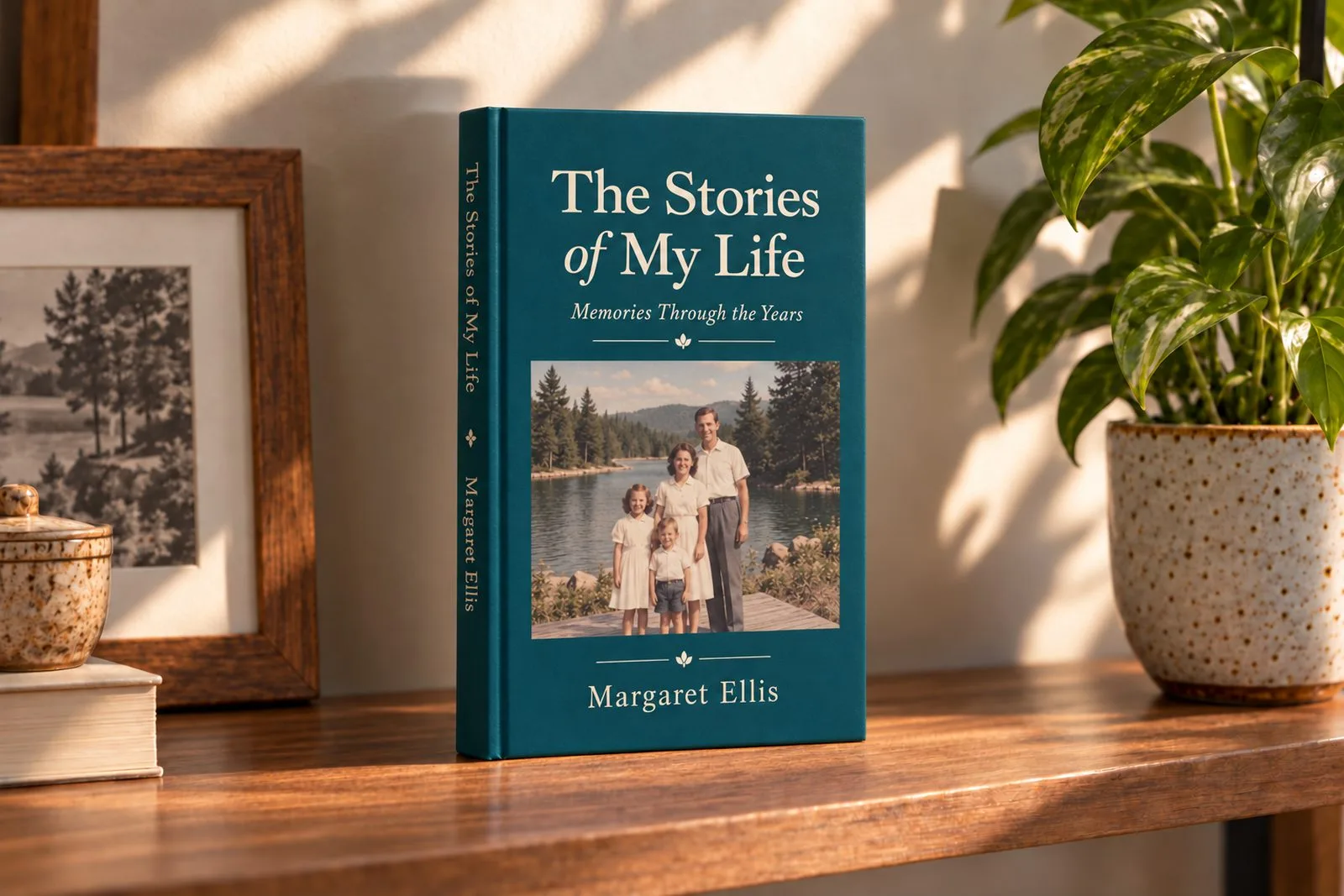
What should you write if the keepsake book is your own story?
Don't start at birth. Start with the story you tell most often, because you already know how it goes. Then let questions find the rest. A few that tend to open things up:
- What did the kitchen in your childhood home smell like?
- Who is the first friend you remember, and what did you do together?
- Which job taught you the most, and who taught it to you?
- What did your parents argue about?
- Where were you when you heard news that everyone remembers?
- What are you proud of that nobody else saw?
For a longer list, try our questions to ask your parents about their life. They work just as well when you're the one answering.
What if you don't know what to write?
Start with the words "I remember." It's hard to finish that sentence with a stock phrase. Write the way you'd say it across the kitchen table, then read it aloud and cut anything you wouldn't actually say. And if a memory feels too small to bother with, write it anyway.
What to leave out
- A run of inside jokes. One is fine, but a page of them shuts everyone else out.
- Long quotations from famous people. A line of your own will mean more.
- Anything you wouldn't want their grandchildren to read.
- An apology for your handwriting. Just write.
If you'd rather give a parent the questions than a blank book, that's what we make. Kindred Tales emails them one question about their life each week for a year, and their answers become the chapters of a hardcover book. If you've already given it, our printable gift note has room for one of the lines above.
What is a keepsake book?
The main kinds, ideas for each, and how to make one or give one as a gift.
Legacy storiesHonoring loved ones through their stories
Ways to keep the memory of someone you love, in their words and yours.
Gift guidanceWhy a life story book makes a good gift
What a year of questions is like for the parent or grandparent answering them.
Questions people ask about what to write
What do you write in a memory book for a friend?
What do you write when you give a book as a gift?
Where do you write an inscription in a book?
How long should a message in a keepsake book be?
What do you write in a memory book if you didn't know the person well?
Give them the questions, and the book that follows
Each week your parent gets one question about their life. They can write back or talk it through, in their own words, and the answers become their own hardcover book.
Start their storyKeep reading

Interview Tips
National Day of Listening: questions to ask the day after Thanksgiving
National Day of Listening falls the day after Thanksgiving. Get questions to ask your mom or dad at the table, plus how to record and keep the answers.
Interview Tips
Questions to Ask Siblings About Your Parents and Childhood
What does each of you remember about Mom and Dad? Questions to ask siblings about your parents and growing up, plus a question game for the holiday table.
Interview Tips
Questions to Ask Your Parents About Their Life, and How to Ask
Questions to ask your parents about their life that open real stories, not one-line answers, plus how to ask and what to do when they deflect.